
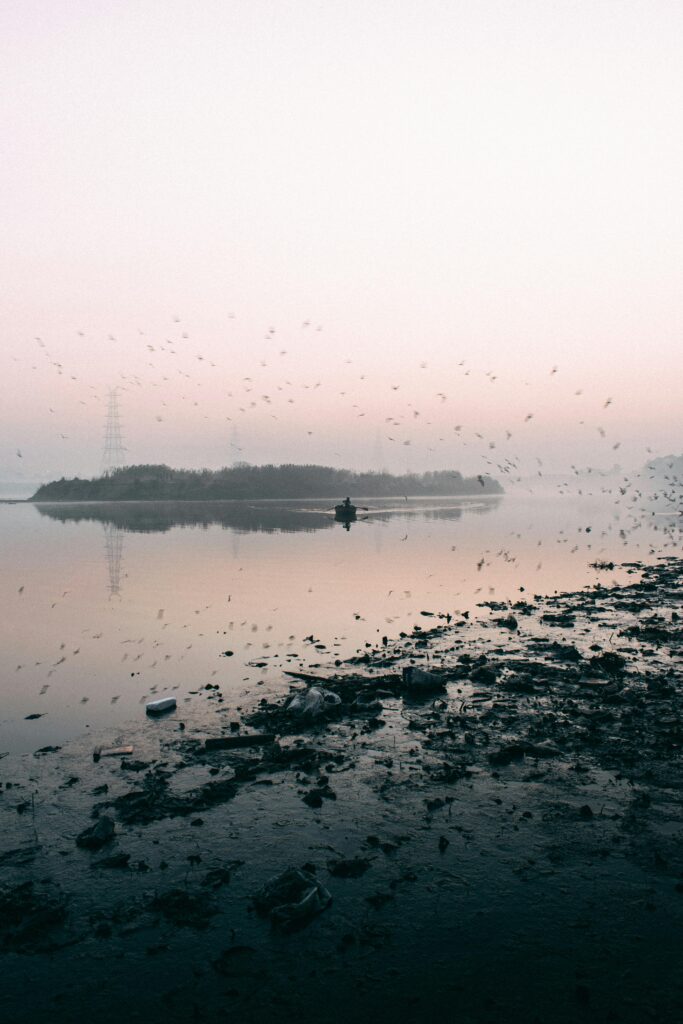
The Gray Shroud: Why Delhi Remains One of the World’s Most Polluted Capitals
Every year, as the festive lights of Diwali fade and the winter chill sets in, a familiar, suffocating gray haze descends upon Delhi. The National Capital Region (NCR) transforms into what many describe as a “gas chamber.” From headlines in the New York Times to urgent health advisories from the World Health Organization (WHO), Delhi’s air quality remains a global case study in environmental crisis.
But why Delhi? Why does a city with massive green belts like the Ridge and aggressive government policies still struggle to breathe? As an expert observer of urban ecology, I’ve broken down the complex web of geography, chemistry, and human activity that keeps Delhi’s Air Quality Index (AQI) in the “Hazardous” zone.
1. The Geographical “Bowl” Effect
To understand Delhi’s pollution, we must first look at its map. Delhi is situated in the Indo-Gangetic Plain, bordered by the Himalayas to the North and the Aravalli Range to the South and West.
This creates a semi-enclosed basin. In the summer, strong winds and high temperatures allow pollutants to disperse vertically into the atmosphere. However, come October, a meteorological phenomenon known as Temperature Inversion occurs. Cold air, being denser, gets trapped near the ground under a layer of warm air. This warm “lid” prevents smoke, dust, and chemicals from rising, effectively locking them at breathing level.
Unlike coastal cities like Mumbai or Chennai, which benefit from sea breezes that “flush” the air, Delhi is landlocked. The air here stagnates, meaning every gram of carbon emitted stays exactly where it was produced.
2. The Stubble Burning Crisis (The Seasonal Trigger)
While pollution is a year-round issue, the “Severe+” spikes in late October and November are undeniably linked to Parali (stubble burning).
Farmers in the neighboring states of Punjab, Haryana, and Uttar Pradesh have a very narrow window—typically 15 to 20 days—to clear their fields of paddy straw before planting wheat. Burning is the cheapest and fastest method.
The Scale: Millions of tonnes of agricultural waste are set ablaze simultaneously.
The Wind Factor: During this period, the prevailing wind direction shifts to the North-West, carrying a massive plume of smoke directly into the Delhi bowl.
Recent 2025-2026 data shows that while farm fires have decreased in number due to government subsidies for “Happy Seeders” and bio-decomposers, the timing of the fires has shifted to late afternoon. This causes the smoke to hit Delhi during the night when the boundary layer is lowest, leading to record-breaking morning AQI levels.
3. Vehicular Emissions: The Internal Engine of Pollution
If stubble burning is the seasonal trigger, vehicular emissions are the “base load” that keeps Delhi’s air toxic throughout the year.
Delhi has the highest vehicle density in India. Despite the expansion of the Delhi Metro and the aggressive rollout of Electric Vehicle (EV) Policies, the sheer volume of internal combustion engines is staggering.
The Diesel Factor: Heavy-duty trucks passing through Delhi (often bypass-bound but still transiting) emit high levels of Nitrogen Oxides (NOx) and black carbon.
Congestion: Pollution isn’t just about how many cars are on the road; it’s about how long they stay there. Idling in Delhi’s notorious traffic jams leads to incomplete combustion, releasing more Carbon Monoxide (CO) and Particulate Matter (PM2.5) than at cruising speeds.
4. The Hidden Culprit: Secondary Particulate Matter
Recent 2026 reports from the Commission for Air Quality Management (CAQM) have highlighted a “hidden” source that accounts for nearly 27% of winter pollution: Secondary Particulate Matter.
Unlike dust or smoke, these particles are not emitted directly. They are formed in the atmosphere through complex chemical reactions between:
Ammonia (NH3): Mostly from agricultural fertilizers and livestock in the NCR.
Sulphur Dioxide (SO2): From power plants and industrial clusters.
Nitrogen Oxides (NOx): From tailpipes.
When these gases mix in the cold, stagnant winter air, they form ammonium nitrates and sulphates—microscopic particles that are small enough to enter the bloodstream directly through the lungs.
5. Construction Dust and Landfill Fires
Delhi is a city in a state of “perpetual construction.” Whether it’s the redevelopment of Central Vista, new metro lines, or private housing, the amount of loose silica and cement dust in the air is immense.
Furthermore, Delhi’s three massive “garbage mountains”—Ghazipur, Bhalswa, and Okhla—frequently catch fire due to trapped methane. These landfill fires release highly toxic dioxins and furans, creating localized “pollution hotspots” that affect millions of residents in East and North Delhi.
6. Industrial Clusters and Brick Kilns
The periphery of Delhi is dotted with industrial zones and thousands of brick kilns. While many have transitioned to Zig-Zag technology (which is more fuel-efficient), many still operate on coal or illegal high-sulphur fuels like pet coke. Because these industries are often just across the border in Uttar Pradesh or Haryana, Delhi’s government has limited jurisdiction to shut them down, highlighting the need for a regional airshed management approach.
The Health Impact: What Are We Breathing?
Living in Delhi during a “Severe” air day is equivalent to smoking roughly 15 to 20 cigarettes a day.
PM 2.5: These are particles smaller than 2.5 micrometers. They bypass the nose and throat and settle deep in the alveoli of the lungs.
Long-term Effects: We are seeing a rise in “Non-Smoker’s Lung Cancer,” chronic asthma in children, and cognitive decline in the elderly.
The Road to 2026 and Beyond: Is There Hope?
The situation is grim, but the narrative is shifting. For the first time in a decade, 2025 and early 2026 have seen the highest number of “Satisfactory” air days outside of the monsoon season.
Key Solutions Currently in Motion:
The 13,000+ Electric Bus Fleet: Delhi is on track to have one of the largest electric public transport systems globally by 2028.
GRAP (Graded Response Action Plan): This is an emergency framework where construction is halted, and “Odd-Even” car rationing is implemented as soon as AQI hits specific thresholds.
The “No PUC, No Fuel” Rule: Strict enforcement of pollution-under-control certificates at petrol pumps is targeting the worst-offending vehicles.
Smog Towers and Anti-Smog Guns: While controversial in their effectiveness at scale, they provide localized relief in high-density areas like Connaught Place.
Conclusion
Delhi’s pollution isn’t caused by a single villain; it’s a “perfect storm” of geography, agricultural tradition, and rapid urbanization. Solving it requires more than just local bans; it requires a trans-boundary effort involving four state governments and the central ministry.
As citizens, while we wait for policy to catch up, the focus remains on personal protection—using N95 masks, installing air purifiers, and transitioning to green mobility. Delhi is the heart of India; it’s time we let it breathe again.